
Aysén or Torres del Paine? Two Ways to Experience Chilean Patagonia
- Parque Cascadas

- Jul 20
- 2 min read
Updated: Jul 27
AYSÉN
By Antonia Anastassiou, Co-founder of Parque Cascadas
I have been traveling to Patagonia Aysén for more than twenty years, and I still feel there is something in this region that cannot be fully explained from a distance. You have to arrive. You have to take the road. You have to feel the humidity in the forest, the sound of the Río Simpson, the silence between the trees.
Torres del Paine is powerful, dramatic and unforgettable — one of the great icons of Chilean Patagonia, with open landscapes, granite towers and glaciers. It is also more developed, more visited, and more obvious in the imagination of the international traveler.
Aysén is something else.
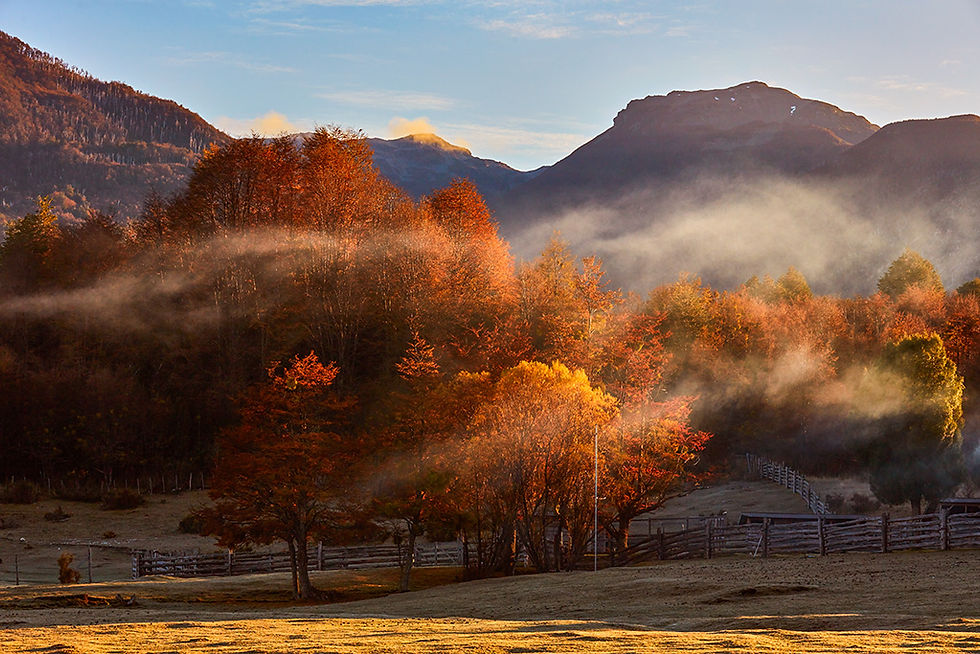
Aysén is more hidden, more intimate, and still wonderfully undiscovered by the masses. Especially in northern Aysén — the part I love most — nature does not open immediately into the horizon. It surrounds you. It holds you inside canyons, native forest, rivers and waterfalls. The greens feel endless.
At Parque Cascadas, near the Río Simpson and Cascada La Virgen, this feeling becomes very clear. Nature is not a view. It is an atmosphere. It enters through the sound of water, the cold morning air, the birds that appear only when you are quiet enough, the way the forest changes after rain.
I was also impressed by the people of Aysén — the gauchos and local men and women who read the weather, the animals, the river and the road, and who do not speak about nature as something separate from themselves. There is a kind of ancestral, practical, humble wisdom in that relationship.
I do not like comparing Aysén and Torres del Paine as if one were better than the other. They are two different ways of experiencing Patagonia. Torres del Paine is the Patagonia of the great icon: open, vast, monumental. Aysén is the Patagonia of intimacy: rivers, forest, rain, canyons, hidden birds, local wisdom, long roads and silence.
Aysén is enormous — more than 108,000 square kilometers and less than one inhabitant per square kilometer, one of the least densely populated regions in Chile. That means space, freedom and discovery. But it also means planning matters: distances are real, weather changes, roads take time.
Parque Cascadas was born from this understanding. A private base between Coyhaique and Puerto Aysén, beside the Río Simpson, created for travelers who want to explore the region without rushing through it. A place to return to after the road. A house by the river. A fire. A forest.
For me, this is the deepest luxury of northern Patagonia: not only to see nature, but to feel that nature gives you back your place in the world.
Comments